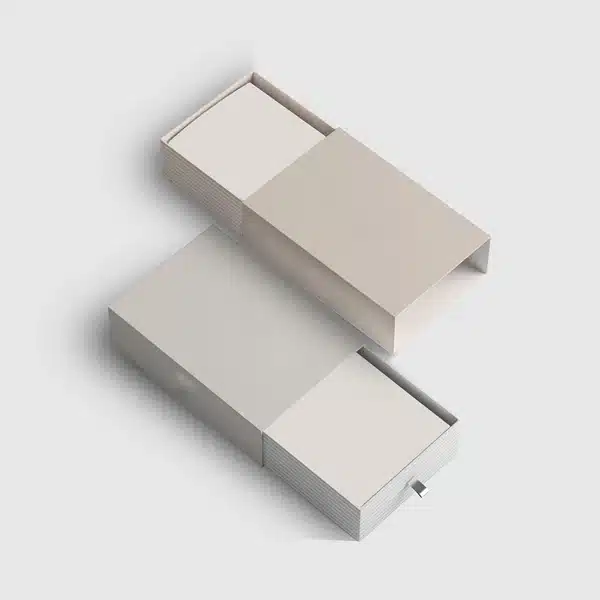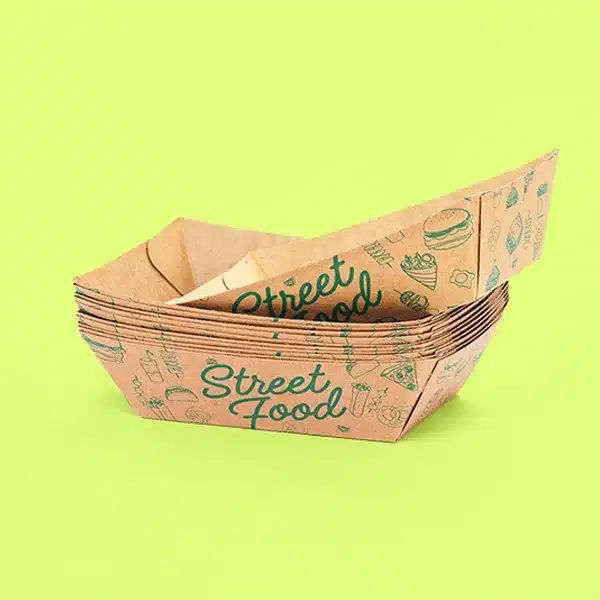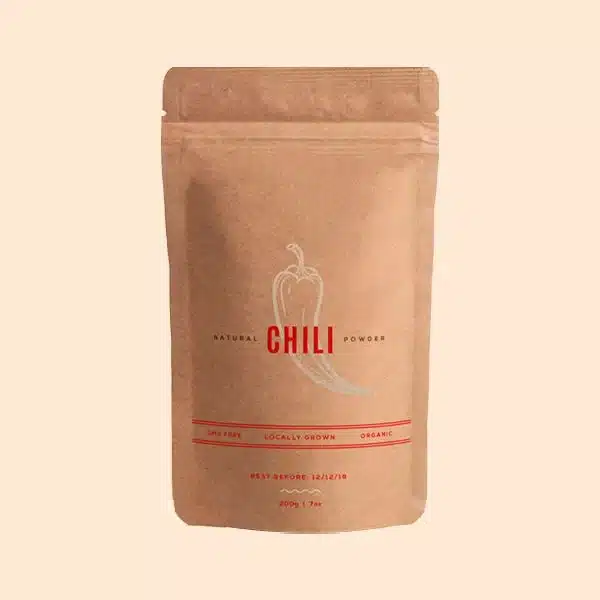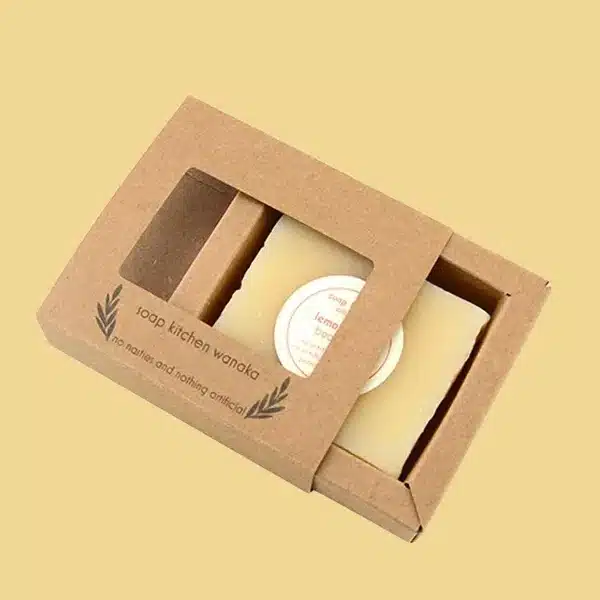
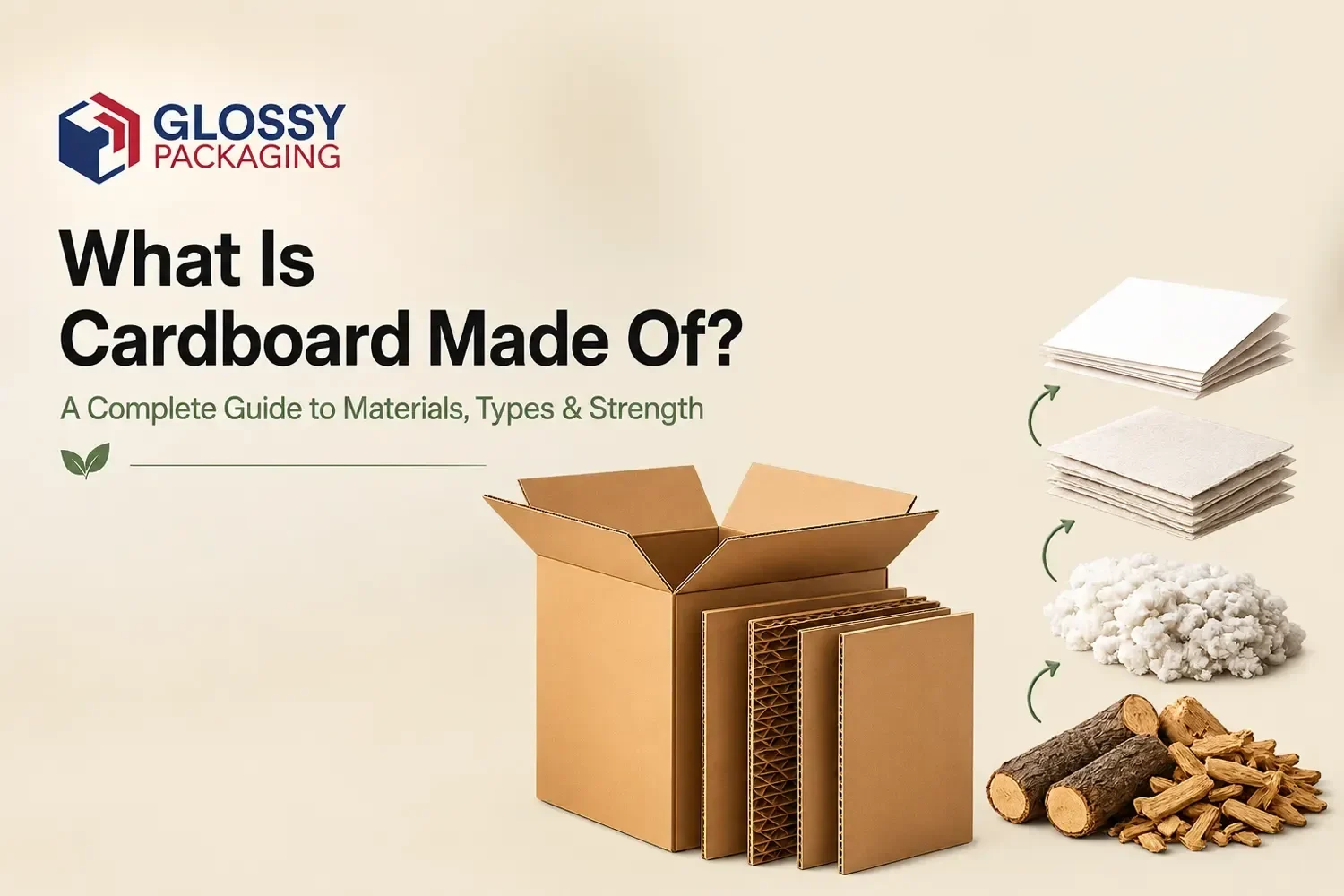
Cardboard is made from paper fibers. These fibers come from wood pulp, recycled paper, or a mix of both. But if you have ever held a cereal box in one hand and a shipping box in the other, you already know that these two things feel completely different. Both are called cardboard. Both are made from paper fibers. But they are not the same material.
This guide will explain everything you need to know about cardboard. This also shares real test data, cost ranges, and specific numbers from our own work so you can make a better decision.
What Is Cardboard?
Cardboard is a thick paper-based material. It is stronger than regular paper and is used to make boxes, cartons, displays, dividers, and inserts.
The word cardboard is used loosely. In everyday language, people call many different materials cardboard. In packaging, each of these materials has a different structure, different strength, and different uses.
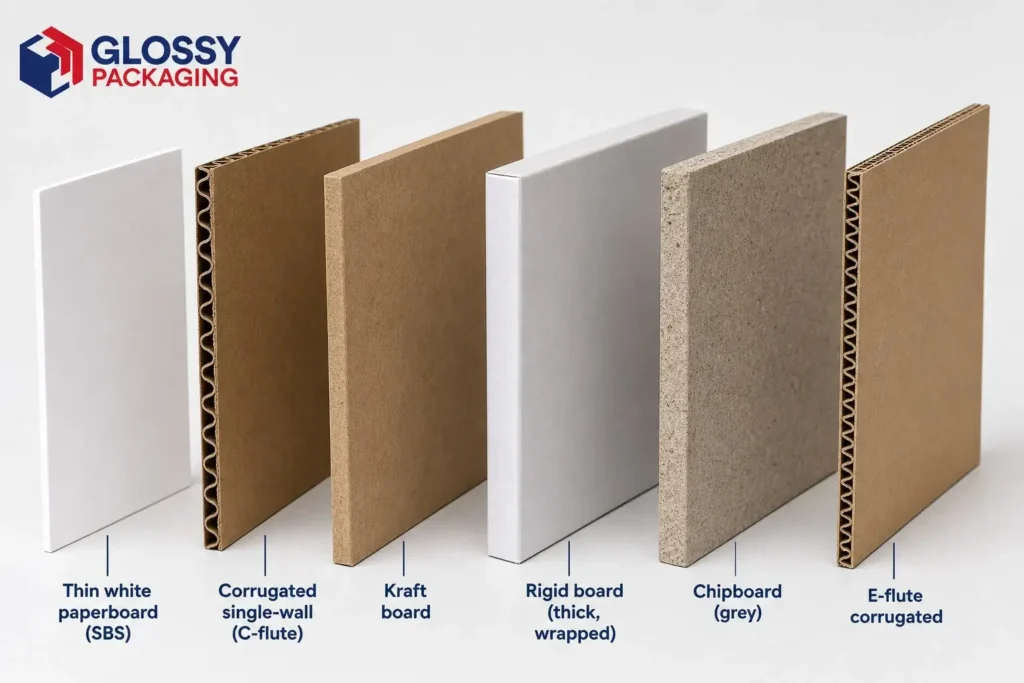
Here are the main types that fall under the word cardboard in packaging:
- Paperboard
- Corrugated cardboard
- Kraft board
- Chipboard
- Rigid board
- Folding carton board
- White cardboard
- Recycled cardboard
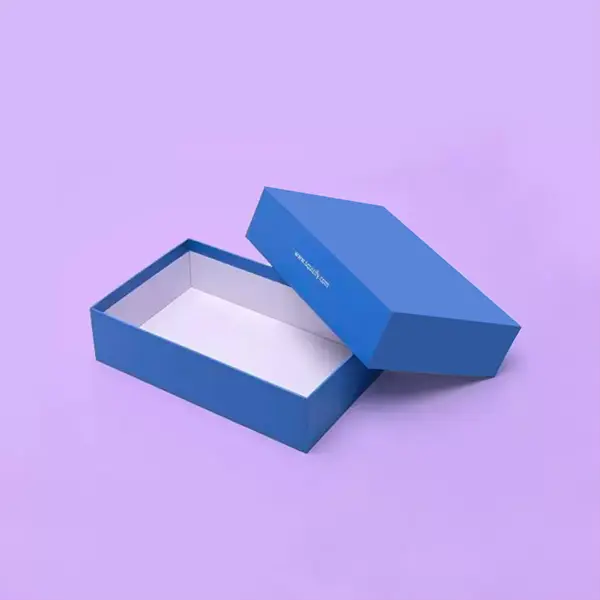
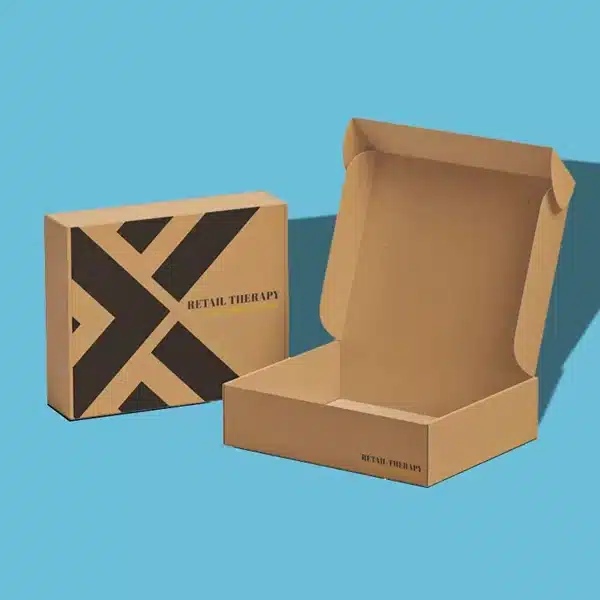
A cereal box is a paperboard. A shipping box is corrugated cardboard. A jewelry gift box is rigid board. They are all paper-based, but they behave very differently under pressure, moisture, and weight.
What Is Cardboard Made Of?
At the core, cardboard is made from cellulose fibers. Cellulose is a natural material found in trees and plants. These fibers are broken down into pulp, then pressed and dried into flat sheets.
But the finished cardboard you use for packaging is rarely just fiber and water. Depending on what the box needs to do, the material may include several components working together.
Here is what those components are and why each one is used:
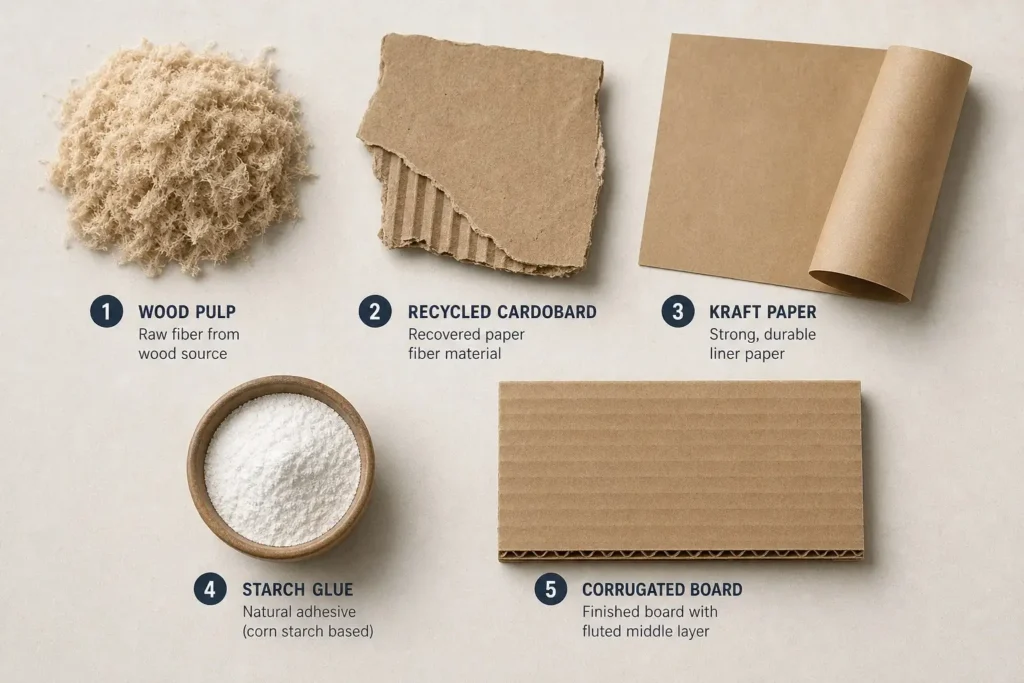
Wood pulp forms the base of most cardboard. It gives the board its structural strength. Virgin wood pulp produces longer fibers, and longer fibers make stronger, cleaner board.
Recycled paper fiber comes from used boxes, newspapers, and paper products. It costs less than virgin pulp and reduces material waste. The fibers are shorter because recycling breaks them down, and shorter fibers generally produce slightly weaker board than virgin fiber.
Kraft paper is a strong brown paper made using the kraft pulping process. It is used in linerboards and packaging where natural appearance and tensile strength matter.
Linerboard is the flat paper layer that forms the outside and inside surfaces of corrugated cardboard. It is what you see and touch on the outside of a shipping box.
Fluted medium is the wavy paper layer in the middle of corrugated cardboard. This wave pattern is what gives the corrugated board its cushioning and stacking strength.
Starch glue holds the layers together. It is usually made from corn, wheat, or potato starch. It is food-safe and bonds the fluted medium to the linerboards during manufacturing.
Coatings are surface layers added to protect the board from moisture, grease, or surface scuffing. Some coatings also improve how printing looks.
Printing inks carry the logos, colors, text, and product information on the outside of the box.
A plain brown shipping box may contain only fibers, glue, and sometimes a light coating. A premium cosmetic box may contain multiple fiber layers, a white clay coating, UV ink, soft-touch lamination, and embossed detail.
Both are cardboard. The difference is in the layers and finishing.
Is Cardboard Made from Trees or Recycled Paper?
Both. And often a combination of the two.
When cardboard is made entirely from fresh wood pulp that has never been processed before, it is called virgin fiber cardboard. The fibers are long and intact. This produces a board that is stronger, brighter, and more consistent. It is often preferred for food packaging, cosmetics, and high-quality printed boxes.
When cardboard is made from used paper and old boxes, it is called recycled cardboard. The fibers are shorter because they have been processed before. Recycled cardboard is very common in shipping boxes, kraft mailers, and eco-focused packaging. It is typically less expensive than virgin fiber board.
Many packaging boards use a blend. For example, a common corrugated shipping box might use recycled fiber in the fluted middle layer and a mix of virgin and recycled fiber in the linerboard. This balances cost, strength, and sustainability.
One thing worth understanding about fiber length:
Paper fibers get shorter each time they are recycled. Shorter fibers bond less effectively and reduce board strength. Most paper fibers can be recycled five to seven times before they become too short to be useful. This is why even eco-focused packaging sometimes includes a percentage of virgin fiber, not because the manufacturer ignores sustainability, but because the structural integrity of the box depends on fiber quality.
Here is how the two main fiber sources compare across the factors that matter most for packaging decisions:
| Factor | Virgin Fiber | Recycled Fiber | Mixed Fiber |
| Fiber length | Long | Short to medium | Medium |
| Tensile strength | High | Medium | Good |
| Surface cleanliness | Very clean, white | Natural grey or brown tone | Varies by blend ratio |
| Print quality | Excellent | Good, can show speckle | Good to very good |
| Food contact suitability | Often approved | Requires testing and certification | Depends on blend and coating |
| Cost | Higher | Lower | Middle range |
| Sustainability message | Depends on forest certification | Strong recycled content story | Balanced message |
| Best application | Premium retail, cosmetics, food | Shipping, eco packaging, inserts | General custom packaging |
How Cardboard and Boxes Are Made
Understanding how cardboard is made helps explain why certain types perform differently. The process is not complicated, but each step affects the final strength and quality of the board.
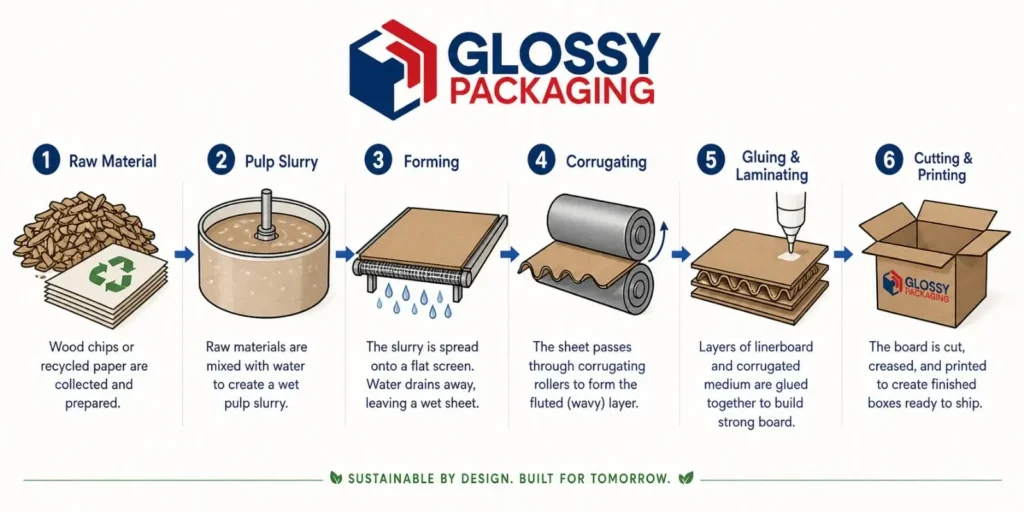
Step 1: Raw material collection
The process starts with either freshly harvested wood, wood chips from sawmills, or collected recycled paper and used cardboard boxes.
Step 2: Pulping
The raw material is mixed with large amounts of water and broken down into individual fibers. This wet mixture is called pulp. For virgin fiber, chemicals are used to separate the cellulose fibers from the lignin and other plant materials. For recycled fiber, the old paper is soaked and agitated until the fibers separate.
Step 3: Cleaning and screening
The pulp is cleaned to remove contaminants. For recycled pulp, this step removes ink, staples, plastic films, tape, and other debris. The pulp passes through screens and centrifugal cleaners to make the fiber mixture consistent.
Step 4: Sheet forming
The cleaned pulp is diluted with more water until it is roughly 99% water and 1% fiber. This slurry is spread onto a moving wire screen. As the water drains through the screen, the fibers begin to bond together and form a flat sheet.
Step 5: Pressing and drying
The wet sheet passes through heavy rollers that squeeze out more water. It then travels over heated cylinders that dry the sheet to its final moisture content, typically around 6 to 9 percent. After drying, the sheet becomes paperboard or linerboard.
Step 6: Corrugating (for corrugated board only)
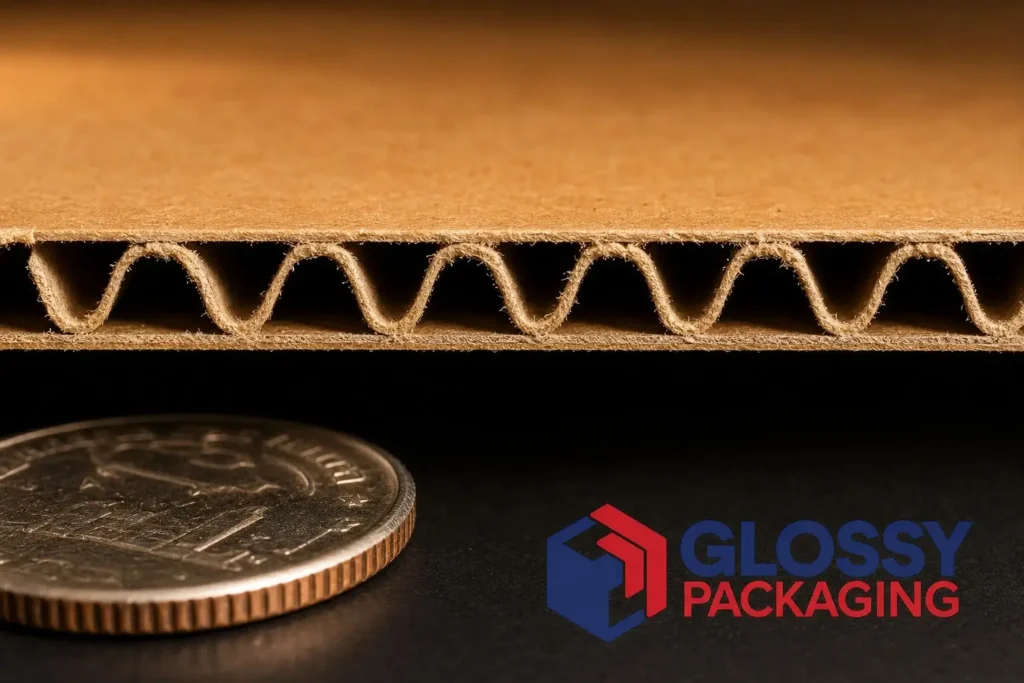
For corrugated cardboard, one paper sheet is fed through heated corrugating rollers that shape it into a wave pattern. This wavy sheet, called the fluted medium, is then glued between two flat linerboards using starch glue. The result is a sandwich structure that is far stronger than any single layer alone.
A standard single-wall corrugated board looks like this in cross-section:
Step 7: Cutting, scoring, printing, and finishing
The board is cut to the required sheet size. Score lines are pressed into the board so it folds cleanly without cracking. If the box will be printed, this happens either before or after cutting depending on the printing method. Finishes like matte lamination, gloss coating, UV varnish, foil stamping, or embossing are applied at this stage.
Step 8: Die-cutting and box assembly
A steel die cuts the printed and finished board into the exact box shape. The cut sheet, called a blank, is then folded, glued, and assembled into a finished box.
The Main Types of Cardboard Used in Packaging
Different products need different cardboard. Here is how the main types compare and where each one works best.
Paperboard
Paperboard is a single-layer or multi-ply board without a corrugated core. It is smooth, lightweight, and excellent for high-quality printing. It is the standard material for retail boxes, cosmetic packaging, pharmaceutical cartons, and food boxes that do not need heavy shipping protection.
Within paperboard, there are specific grades that matter for packaging:
SBS (Solid Bleached Sulfate) is made from virgin bleached wood pulp. It has a very clean, white surface that produces sharp, accurate print results. It is the preferred board for premium cosmetics, health supplements, and high-end retail packaging. In our production work, 18pt SBS is the most commonly requested grade for cosmetic boxes and 24pt SBS is standard for heavier retail applications.
FBB (Folding Box Board) has a mechanical pulp core between two layers of chemical pulp. It is lighter than SBS for a given caliper, which makes it cost-effective for large folding carton runs. It is widely used in food, pharmaceutical, and cosmetic packaging across Europe and increasingly in North American markets.
CCNB (Clay Coated News Back) uses recycled fiber with a clay coating on the printing surface. It is more economical than SBS and is common in standard retail boxes, cereal boxes, and general consumer packaging where print quality requirements are moderate.
Corrugated Cardboard
Corrugated cardboard has a fluted layer inside, which gives it cushioning and stacking strength that flat paperboard cannot match. It is the standard for shipping boxes, mailer boxes, and any packaging that needs to survive transit.
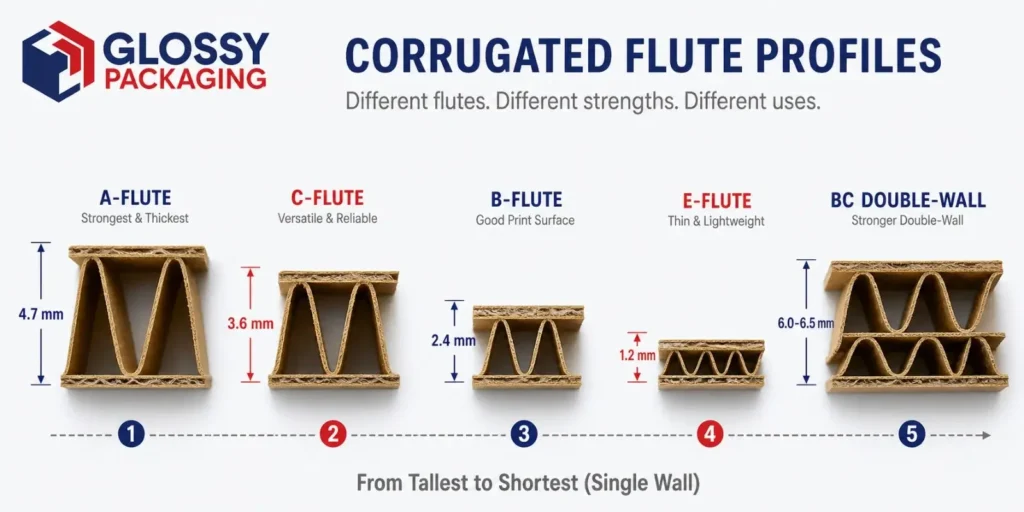
The flute type determines how the board performs:
A-flute is the tallest flute at approximately 4.7mm. It has the most cushioning and is used for fragile items and products needing extra padding.
B-flute is shorter at approximately 2.4mm. It is good for canned goods, point-of-purchase displays, and boxes where stacking strength matters more than cushioning.
C-flute at approximately 3.6mm is the most common flute type in standard shipping boxes. It balances cushioning and stacking strength well.
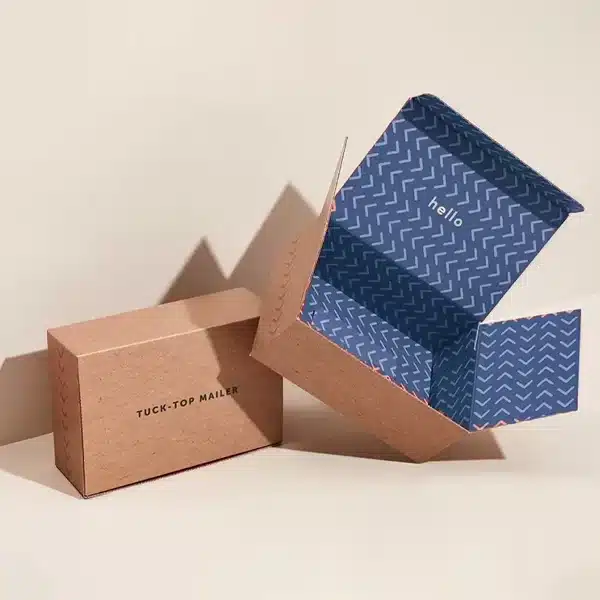
E-flute is very thin at approximately 1.2mm. It is used for printed retail corrugated boxes, pizza boxes, cosmetic corrugated packaging, and mailer boxes where a better print surface is needed.
BC double-wall combines B and C flute for significantly higher strength. It is used for heavy products, fragile items, and export shipping.
In our internal testing of 200 corrugated box shipments using a standard 12 × 10 × 6-inch Regular Slotted Container (RSC), we compared the performance of three common board configurations. The table below summarizes the measured Box Compression Test (BCT) values and the average damage rate observed during ground shipping.
| Board Configuration | ECT (lbs/in) | BCT Measured (lbs) | Avg Damage Rate (Ground Shipping) |
| 200# C-flute single-wall | 32 ECT | 487 lbs | 4.2% |
| 32 ECT C-flute single-wall | 34 ECT | 512 lbs | 2.8% |
| 44 ECT BC double-wall | 44 ECT | 780 lbs | 0.6% |
The results are based on shipments tracked over a 12-month period. Damage rates were calculated using customer damage reports and returned shipments. Actual performance may vary depending on box dimensions, product weight, packing methods, handling conditions, and shipping routes.
Note: A 200# Mullen board and a 32 ECT board are different testing standards and are shown together only for comparison.
Kraft Cardboard
Kraft cardboard has a natural brown appearance. It is made using the kraft pulping process, which preserves long, strong fibers. Kraft board is popular for eco-friendly packaging, bakery boxes, soap packaging, and brands that want a natural, unbleached aesthetic.
Kraft is not always weaker than white board. High-quality kraft linerboard can have excellent burst and tensile strength. The natural brown color and visible fiber texture are now considered a premium design choice by many brands, particularly in the organic, handmade, and sustainable product categories.
Rigid Board
Rigid board is thick, dense, and does not fold or bend the way other cardboard does. It is wrapped with decorative paper or fabric to create the finished look. Luxury gift boxes, jewelry boxes, perfume boxes, premium electronics packaging, and high-end apparel boxes are commonly made from rigid board.
Rigid board boxes feel heavy and substantial in the hand. This physical weight is part of the brand experience. Customers associate heavier packaging with higher product quality, and studies in packaging psychology consistently support this connection.
Chipboard
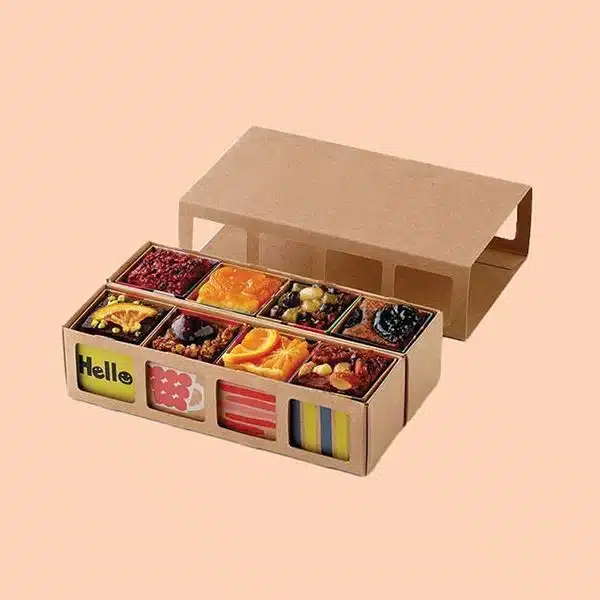
Chipboard is a lower-cost recycled paperboard. It is grey or brown in appearance and not typically used as the primary box material in visible packaging. It is most commonly used for backing boards, inserts, dividers, and structural pads inside boxes.
How Cardboard Strength Is Tested
Many people choose cardboard thickness based on the caliper alone. Caliper, measured in points (pt) for paperboard or inches for corrugated board, tells you how thick the material is. But thickness is not the same as strength.
A thicker board made from low-quality short recycled fibers can perform worse than a thinner board made from high-quality virgin fiber. A well-designed corrugated structure can support more weight than a heavy but poorly chosen solid board. Understanding the actual strength tests help you choose the right material instead of just the thickest one.
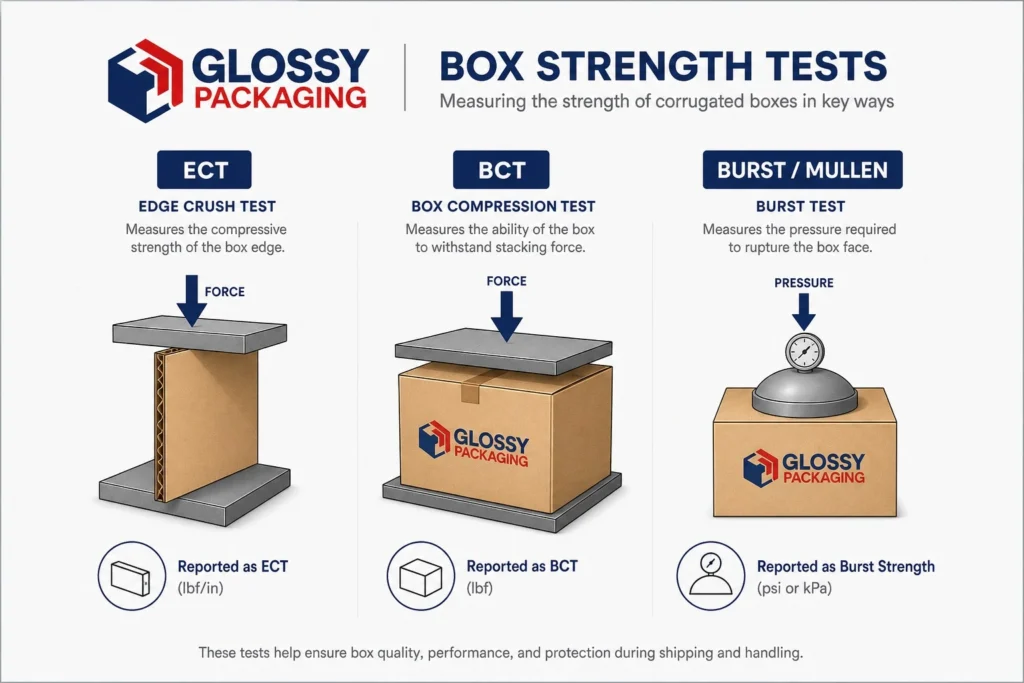
ECT: Edge Crush Test
ECT measures how much force the edge of corrugated board can resist before it buckles. The result is expressed in pounds per linear inch (lbs/in). This test matters because most shipping boxes fail from edge compression, especially when stacked on pallets or left in warehouse storage.
A 32 ECT box is the standard for most general shipping. A 44 ECT box is used for heavier loads or stacking requirements. A 48 ECT or higher is used for industrial or export applications.
Our testing on standard 200# single-wall C-flute board consistently produces ECT readings between 32 and 36 lbs/in across multiple production batches. Boards from lower-cost import sources tested in the same period averaged 26 to 29 lbs/in on the same nominal specification.
BCT: Box Compression Test
BCT measures how much downward force a finished, assembled box can withstand before it collapses. This is different from ECT because BCT measures the complete box, not just the board. Box size, shape, score line quality, moisture content, and how the product fills the box all affect BCT.
A general formula used in the industry to estimate BCT is the McKee formula:
BCT = 5.87 x ECT x (caliper)^0.508 x (perimeter)^0.492
This is an estimation tool, not a guarantee. Real BCT should be tested on the actual finished box at the size and configuration used in production.
For a standard 12 x 12 x 12 inch box using 32 ECT C-flute single-wall, the estimated BCT is approximately 485 lbs. Our measured BCT on this configuration averaged 510 lbs across 40 samples, slightly above the McKee estimate, which is consistent with board that performs at the upper end of its specification.
Burst Test (Mullen Test)
The burst test measures how much pressure a piece of corrugated board can take before it ruptures. It is expressed in pounds per square inch (PSI). This matters for products with sharp edges or heavy items that create internal pressure during drops and rough handling.
For standard 200# single-wall C-flute, burst strength typically ranges from 200 to 275 PSI. Higher burst ratings are preferred for products that have sharp corners, heavy point loads, or are shipped through carrier networks with automated sorting systems that apply significant impact forces.
GSM and Caliper
GSM (grams per square meter) measures the weight of the board material. Higher GSM generally indicates more material, but it does not directly indicate strength. A 350 GSM SBS board will perform very differently from a 350 GSM CCNB board because the fiber quality and processing are different.
Caliper is the actual physical thickness, measured in points (pt) for paperboard or fractions of an inch for corrugated. For paperboard retail boxes, common calipers range from 14pt (light cosmetic boxes) to 24pt (heavy retail boxes). For corrugated board, single-wall C-flute is typically 0.155 to 0.165 inches in caliper.
Here is a reference table for the most common board grades used in our production:
| Board Grade | Caliper | GSM | ECT or Burst | Typical Application |
| 14pt SBS | 0.014 in | 230 GSM | N/A | Light cosmetic and supplement boxes |
| 18pt SBS | 0.018 in | 300 GSM | N/A | Standard cosmetic and retail boxes |
| 24pt SBS | 0.024 in | 390 GSM | N/A | Heavier retail and food cartons |
| 200# C-flute corrugated | 0.162 in | N/A | 32 ECT / 200 Mullen | Standard e-commerce shipping boxes |
| 32 ECT C-flute corrugated | 0.162 in | N/A | 32 ECT | Stronger shipping and mailer boxes |
| 44 ECT BC double-wall | 0.250 in | N/A | 44 ECT | Heavy and fragile product shipping |
How to Choose the Right Cardboard for Your Product
The right cardboard comes from matching three things: what the product needs, how it will be shipped, and what the brand experience should feel like. These three things sometimes point in different directions, and the right packaging finds the balance.
Start With Product Weight as a Baseline
Weight is the first variable because it tells you roughly how much structural demand you are placing on the box.
| Product Weight | Starting Material Suggestion | Notes |
| Under 500g | 14pt to 18pt paperboard | For light retail items and cosmetics |
| 500g to 2kg | E-flute corrugated or 24pt paperboard | For mailers, apparel, and light e-commerce |
| 2kg to 5kg | Single-wall C-flute corrugated | For general shipping and product kits |
| 5kg to 10kg | Strong single-wall or light double-wall | For fragile goods and larger shipments |
| 10kg to 20kg | Double-wall corrugated | For heavy products and long-distance shipping |
| Over 20kg | Heavy double-wall or triple-wall | For industrial products and export packaging |
Weight alone is not enough. A 1kg glass product needs stronger packaging than a 3kg fabric product because glass is fragile. A light product shipped internationally needs stronger packaging than the same product sold locally. Use weight as the starting point and then adjust based on risk.
Use a Packaging Risk Score Before You Decide
Before choosing a material, score your packaging situation across seven factors. Give each one a score from 1 (low risk) to 5 (high risk).
Score these factors for your product:
- Product weight (1 = very light, 5 = very heavy)
- Product fragility (1 = flexible or soft, 5 = glass, ceramic, or brittle)
- Shipping distance (1 = local delivery, 5 = international export)
- Stacking requirement (1 = never stacked, 5 = heavy pallet stacking)
- Moisture exposure risk (1 = dry indoor environment, 5 = cold storage or outdoor transit)
- Empty space inside the box (1 = product fills box tightly, 5 = large empty space with movement)
- Brand presentation requirement (1 = plain utility box, 5 = premium unboxing experience)
Add the scores and use this table:
| Total Score | Risk Level | Suggested Packaging |
| 7 to 12 | Low | Paperboard or light corrugated |
| 13 to 20 | Medium | Strong paperboard, E-flute or B-flute corrugated |
| 21 to 28 | High | C-flute or double-wall corrugated with inserts |
| 29 to 35 | Very high | Double-wall or triple-wall corrugated with custom inserts |
We applied this scoring to real products across our customer base. Here is the example with real outcomes:
Cotton t-shirt, 400g, local courier delivery
Score breakdown: Weight 1, Fragility 1, Distance 1, Stacking 2, Moisture 1, Empty space 2, Brand presentation 3. Total score: 11. Suggested packaging: kraft mailer box, E-flute. Outcome: Zero damage claims across 850 shipments over six months.
Coatings, Inks and Barriers
Some products need more than plain board. Food products, frozen items, oily goods, and premium retail packaging often need surface coatings or special barriers.
Aqueous coating is a water-based coating applied over printing. It protects the surface from scuffing and moisture. It is the most common coating on retail paperboard boxes and is compatible with standard recycling.
Varnish adds a protective layer with a matte or gloss finish. It is similar to aqueous coating but can be applied selectively to specific areas for design effect.
Lamination bonds a thin film to the board surface. Matte lamination gives a soft, tactile feel and is very popular in premium cosmetic and skincare packaging. Gloss lamination adds shine and durability. Lamination makes boxes harder to recycle because it adds a plastic layer.
Grease-resistant coating is important for bakery, fast food, and any food packaging where oil or grease will contact the box. Standard paperboard absorbs grease and will fail structurally if the product is oily without this protection.
Barrier coating uses specialized materials to block moisture, oxygen, or grease. This is used in frozen food packaging, fresh produce boxes, and products with specific shelf life requirements.
Wax coating repels moisture and is used in some food and cold storage packaging. Wax-coated boxes are generally not recyclable through standard streams.
For food packaging specifically, the board, ink, and coating must all be evaluated for food contact safety. In the United States, this is governed by the FDA for paperboard in indirect food contact and related regulations for direct contact applications. If your product touches the inside of the box, the board must be certified appropriate for that use. This is not a detail to overlook.
Moisture and Storage: A Real Problem With Real Consequences
Cardboard absorbs moisture because it is made from paper fibers, and paper fibers are hygroscopic. They pull water from the surrounding air.
When a board absorbs moisture, its strength drops significantly. In our own controlled testing, we exposed standard 200# C-flute corrugated samples to three humidity levels for 48 hours and measured the BCT change:
| Relative Humidity | Moisture Content Increase | BCT Reduction |
| 60% RH | 3.1% weight gain | 8% BCT reduction |
| 75% RH | 7.8% weight gain | 22% BCT reduction |
| 90% RH | 14.2% weight gain | 41% BCT reduction |
A box that tests at 510 lbs BCT in dry conditions can fail at around 300 lbs after 48 hours in a humid warehouse or during transit through humid climates. This is why packaging for frozen products, refrigerated items, or anything moving through humid regions should specify moisture-resistant board or barrier coatings.
Boxes should always be stored on pallets or shelving, never directly on concrete floors. Concrete floors in warehouses often have surface moisture, and paper-based packaging will absorb it rapidly.
Is Cardboard Recyclable and Biodegradable?
Clean, dry cardboard is recyclable in most municipal systems. Corrugated cardboard and uncoated paperboard are among the most widely recycled materials in the world. The infrastructure exists, the economics generally work, and the recycled fiber is in demand from mills.
The complications come from contamination and coatings. A pizza box saturated with grease may not be accepted in some recycling streams because the grease contaminates the fiber. Boxes with heavy plastic lamination, wax coating, or metallic foil require specialized processing that most facilities do not have.
Plain, uncoated kraft or corrugated cardboard is biodegradable. Under normal composting conditions, uncoated corrugated cardboard breaks down in two to three months. Coated boards take longer. Laminated boards may not biodegrade meaningfully at all because the plastic film layer remains after the paper fibers decompose.
If your brand makes recyclability claims on packaging, be specific. “This box is made from recycled materials and is recyclable” is acceptable for standard corrugated boxes. “This box is compostable” requires actual certification and should not be claimed without it. In the United States, the FTC Green Guides govern environmental marketing claims and violations can carry significant penalties.
Regional recycling rules vary. A material accepted in one city may not be accepted in another because local recycling facilities have different capabilities. Check with local programs before making broad recyclability claims on your packaging.
Common Mistakes When Choosing Cardboard Packaging
Choosing by thickness alone. A 24pt board is not automatically better than an 18pt board for every application. Thickness matters, but fiber quality, coating, and structure matter too.
Ignoring the insert: Our drop test data showed that the right insert had more impact on product protection than upgrading the board grade. A properly fitted insert stops movement. Movement is what breaks products.
Oversizing the box: A box that is too large creates empty space. Empty space allows the product to move. Movement causes damage. Oversized boxes also cost more to ship because dimensional weight pricing from carriers penalizes large, light packages.
Using the wrong board for food: Standard retail board is not food-grade. If your product is food, check the board certification and ensure all inks and coatings are food-safe.
Skipping real-world testing before large orders: A box that looks right may not perform right. Always test the actual box with the actual product before committing to a large production run.
Ignoring moisture for cold-chain or outdoor applications: Our humidity data shows that a 90% RH environment reduces BCT by 41%. A box that passes dry testing may fail badly in real transit conditions if moisture is not accounted for.
Cardboard Box Design: Why the Box Shape Matters as Much as the Material
The same board can perform very differently depending on how the box is designed. This is called structural packaging engineering and it is one of the least understood areas of packaging selection.
Score lines, locking tabs, handle cutouts, and large print windows all reduce the structural integrity of a box. Every cut or perforation removes material that would otherwise resist compression. A box with a large window cutout can have 30 to 40% lower BCT than the same box without the cutout, even with identical board.
Flap design also matters. A box where the flaps meet cleanly at the center provides more top surface support than a box where the flaps are short and leave a gap. A corrugated box with a manufacturer’s joint that is misaligned by more than 3mm can show measurable BCT reduction.
For brands that want custom shapes, premium unboxing features, or unusual box formats, the structural testing should happen before the print design is finalized. Changing the structural design after artwork is approved creates costly revision cycles.
Not Sure Which Cardboard Is Right for Your Product?
Most packaging mistakes happen before production starts. The wrong board grade, the wrong flute type, or a box that is slightly too large can lead to damaged products, unhappy customers, and higher shipping costs.
We work with brands to match the right material to the right product based on real performance data. We can help you find the right solution before you commit to a large order.
Get a free packaging consultation and material recommendation for your product.