
Custom Luxury Candle Boxes
Get free shipping, clear pricing, efficient service, and 3D design assistance in every packaging project.
Need more this year? Save 30% on Bulk Orders
What Makes Glossy Custom Packaging Unique
No Die & Plate Charges
Enjoy the advantage of no extra charges for die and plate setups on your custom orders.
No Minimum Order Qty
You can order any quantity you need, whether it's a small batch or a large order, with no minimum quantity restrictions.
Free Design
Get professional design services at no extra cost, ensuring your vision is brought to life with precision.
Quickest Turnaround
Enjoy fast processing and delivery, ensuring the quickest turnaround time for your orders.
Cheapest Prices
Take advantage of the most competitive prices in the market, without sacrificing quality.
Free Shipping
Enjoy the added benefit of free shipping on all orders, making your purchase even more cost-effective.
GET CUSTOM QUOTE
Get a free consultation and your sample kit to help you feel more confident about choosing Glossy Packaging as your custom product packaging partner.
You spent weeks on the wax, the wick, and the scent. The box should not be the part you rush. A custom candle box does three things at once. It protects the candle in shipping. It tells your customer who you are. And it makes the opening feel like a small event.
We have printed custom candle boxes since 2022. In 2025 alone, we shipped 1,241 orders. We work with first-time makers at home. We also work with retail brands that sell 50,000 units a month.
The boxes are different. The questions are the same. What material holds my candle without breaking. What finish makes my brand look right. How fast can I get them? And how much will it cost per box when I scale.
We start at 200 units. We ship in 10 to 14 business days. Free design help, free shipping, and a defect rate we track and publish.
A candle without a box is a product. A candle in a good box is a gift, a memory, and a reason to come back.
Customers keep the box. They put it in a drawer or a closet. They see your logo every time they reach for it again. That is free marketing for years.
On the practical side, Candles are fragile. Glass jars crack. Wax softens in heat. Scent leaks through cheap board. A bad box can ruin a $28 candle before it reaches the buyer. A well made box protects the scent, holds the weight, and survives the trip from your warehouse to their door.
The third reason is shelf presence. In a store, your candle sits next to 40 other candles. The buyer picks one up, reads the box, smells the candle, and decides in under 10 seconds. The box is the first thing they see and the last thing they forget.
Here are the four materials we print most often.
| Material | Thickness | Best For | MOQ | Cost Index |
| Cardboard | 18pt to 24pt | Votives, small jars, gift sets | 200 | $ |
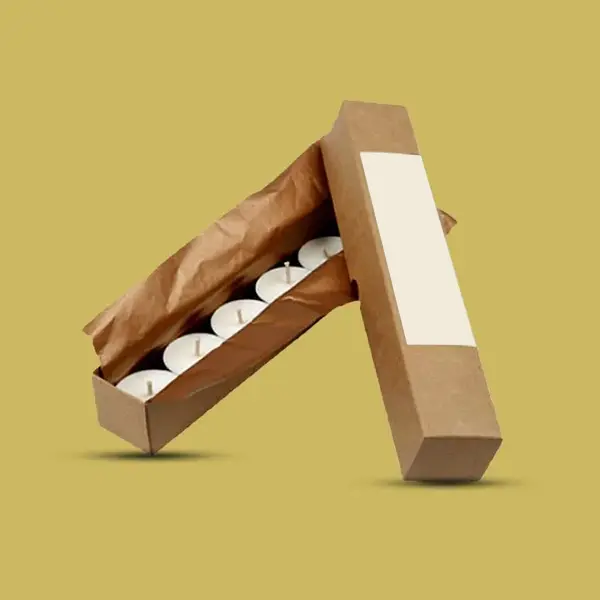
| Kraft | 300gsm to 350gsm | Eco brands, organic candles | 200 | $ |
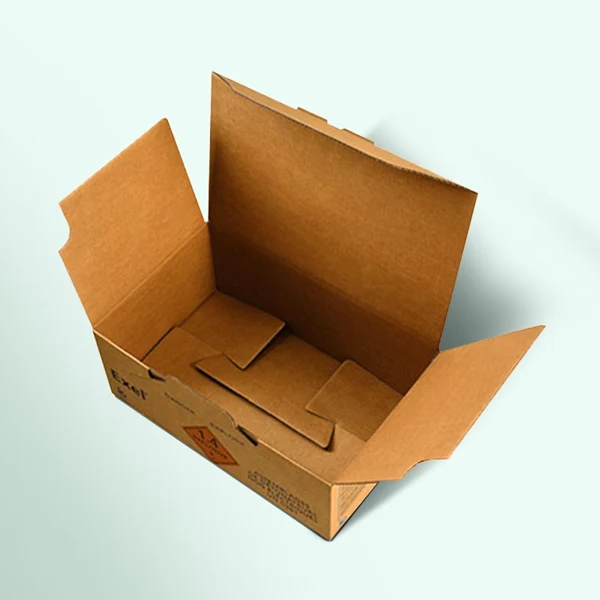
| Corrugated | E-flute, B-flute | Heavy jars, fragile pillars, e-commerce | 200 | $$ |
| Rigid | 1.5mm to 2.5mm | Luxury candles, gift sets | 200 | $$ |
Dollar sign means the cost per box. Same box size, same print. Only the material changes.
The wrong material is the most common mistake we see. A new brand picks cardboard because it is cheap. Then they ship a 14 oz glass jar in a 350gsm box. The box crushes in transit. The customer gets a broken candle. The brand eats the cost and learns the hard way.
Here is how we think about it. Ask three questions. How heavy is my candle. How far does it ship. And what does my brand say.
Candle under 6 oz, sold in local stores. Use cardboard. It is light and smooth. It takes bright full color print. It costs the least. Most retail votive and small gift sets use 18pt to 24pt cardboard.
Candle under 6 oz, eco brand. Use Kraft. It is brown, unbleached, and made from recycled paper. The natural look says eco before the customer reads one word.
One warning!
Kraft paper allows air to pass through, so strong scents like oud, smoke, and vanilla can slowly escape over 7–10 days. We tested this. Standard petroleum based inks can create odors that affect the fragrance after about 6 days. Soy based, low-odor inks help keep the original scent for up to 14 days.. If your scent is strong, ask for soy based ink and a sealed inner bag.
Candle over 8 oz, ships across the country, or sells on Amazon. Use corrugated. It has a wavy paper layer between two flat sheets. That wave absorbs drops and pressure. We drop tested it from 4 feet with a 1.2 kg jar inside. The box held. The jar did not crack.
Use E-flute for 8 to 16 oz jars. Use B-flute for anything over 16 oz. Yes, corrugated costs more per box. But it costs less than one returned shipment of broken candles.
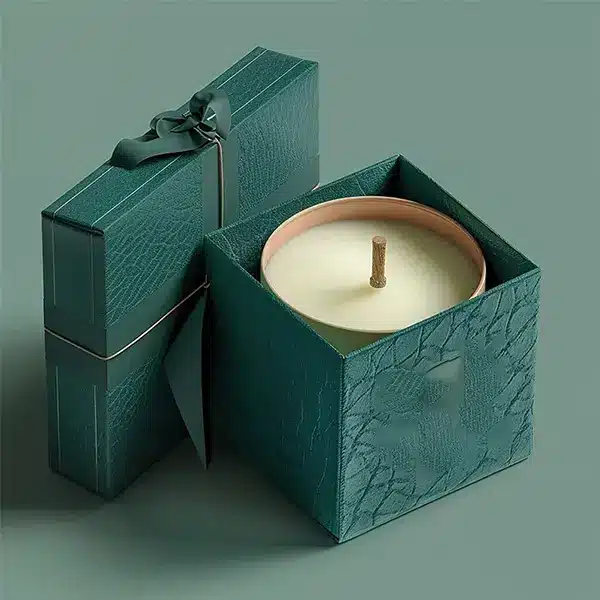
Luxury candle over $35, or a gift box. Use rigid. The walls do not bend. The lid lifts off clean. Add a foam insert and the candle cannot move. Brands like Jo Malone and Diptyque use rigid for this reason. The cost is high and the MOQ is 200 units. But at a $35 price point, rigid pays for itself in how customers talk about the unboxing.
Asad, our packaging engineer, has worked on over 400 candle box orders. His honest take is this. “We no longer recommend rigid for candles under 6 oz. The cost per unit eats your margin. We tell small brands to start with cardboard, grow into rigid. There is no prize for using a luxury box on a $14 candle. The customer feels the mismatch.”
A box style changes how the candle is packed, how the box opens, how it ships, and how it looks on a shelf. Picking the wrong style cost you time and money. Here is how we walk new customers through it.
Glass jars. Choose a tuck end box or a mailer box. A tuck end box is for retail shelves. The flaps tuck in and it opens clean. Use it for candles under 8 oz. A mailer box is for shipping. It has a lock flap and a tear strip. It holds inserts and tissue paper. Use it for 8 oz and up, and for any order you mail to a customer.
Pillars, blocks, and wide tins. Choose a corrugated mailer or a roll end tuck top. The mailer is safest for shipping. The roll end tuck top looks cleaner on a shelf and assembles in 5 seconds. Pick mailer for transit. Pick roll end for display.
Small tins, votives, and samples. Choose a reverse tuck or a top tuck. A reverse tuck looks balanced and fits tins from 2 oz to 6 oz. A top tuck is faster to make and easy to pack. Gift sets and party favors often use a top tuck because 6 or 12 fit in one master carton with no wasted space.
Luxury candles and gift sets. Choose a rigid box with an insert. Foam is the most premium. Molded pulp is the most eco. Folded paper is the cheapest. We recommend foam for glass, pulp for tins, and paper for sample sets.
Three styles to avoid in some cases. Snap lock bottoms look strong, but the base can crack under weight. We saw one fail at 14 oz. Use a tuck end instead. Straight tuck boxes let tapered candles slide around. Add a custom insert. Black cardboard looks great but absorbs heat. If your candle ships to a hot state in summer, the wax can soften. Use kraft with black print instead.
Print is where your box stops looking like a box and starts looking like your brand. We offer three print methods. Each has a different cost, and a different look.
Digital printing is the fastest. Setup cost is low and the color range is wide. The one catch is consistency. If you reorder 6 months later, the color may shift a little. For a new brand testing a design, digital is the right call.
Offset printing is the standard for large quantities of boxes. The color matches on every run. The print is sharp. The cost per box drops as your volume grows. If your design is final and you plan to reorder, use offset.
Screen printing is for bold colors, kraft, and metallic inks. The ink sits on top of the paper, so the kraft texture shows through. It costs more and takes more time. Use it for limited editions and seasonal runs.
What we tell friends who ask for the cheapest print is simple. Go digital under 300 units. Go offset at 500 and up. Anything else and you pay for something you do not need. This is the same advice we give our own customers, and it has saved them thousands of dollars over the years.
The finish is the last thing the customer touches. It is the difference between a box that feels like a product and a box that feels like a gift.
Glossy is bright and shiny. Colors pop on a retail shelf. But it shows fingerprints fast.
Matte is soft and modern with no glare. Most of our candle brands pick matte. It is also cheaper than soft touch, so it is the safe budget pick.
Soft touch feels like velvet. Luxury brands use it. It costs about $0.08 more per box than matte. For a $35 candle, that is a fair trade. For a $12 candle, skip it.
Spot UV puts high gloss on one part of the box, usually the logo, while the rest stays matte. The contrast makes the logo catch the light. It was our most popular finish in 2025. We printed 32,000 spot UV boxes in Q4 alone.
One tip for kraft. Matte alone on kraft looks flat. Spot UV over matte kraft looks three times more premium for about $0.04 per box. It is the best cheap upgrade we offer.
There is no industry standard size. But most candles fit one of these.
| Box size in inches | Fits |
| 2 x 2 x 2.5 | 2 oz votive |
| 2.5 x 2.5 x 2 | 4 oz tin |
| 3 x 3 x 3.5 | 8 oz jar, the most common candle size in the US |
| 4 x 4 x 4.5 | 16 oz jar, the standard large home candle |
| 3 x 3 x 6 | 6 inch pillar |
| 1 x 1 x 10 | one taper candle |
| 4 x 4 x 10 | a set of 3 tapers with a divider |
How to measure. Measure your candle at the widest point and the tallest point. Then add 0.125 inches on each side. A loose candle rattles in shipping. A tight candle is hard to pull out. A snug fit feels right.
If your candle is a custom shape or a custom size, Send us your dimensions. We cut a dieline in 1 to 2 business days. A dieline is the flat template we use to print and cut your box. Production starts after you approve it.
We shipped 1,241 custom candle box orders in 2025. We tracked every order and every defect. Here is what the numbers show.
Who ordered. Retail brands made up 42% of orders. Online brands on Shopify and Amazon made up 31%. Corporate gifting made up 18%. Weddings and events made up 9%. This split has stayed almost steady for two years. Wedding brands are our smallest group, but they reorder the most.
| Style | Orders |
| Tuck end box | 397
|
| Corrugated mailer | 294
|
| Reverse tuck box | 242
|
| Top tuck box | 183
|
| Rigid setup box | 125
|
The tuck end box is the most used style in the candle industry. Not sure where to start? Start there.
| Material | Defect rate |
| Cardboard | 0.6% |
| Kraft | 0.3% |
| Corrugated | 0.2% |
| Rigid | 0.1% |
Our overall defect rate was 0.4%. That is about 5 orders with a defect out of 1,241. Each one got a free reprint or a refund. Cardboard fails most because it is the thinnest and gets used in the hardest jobs. Rigid fails least because it is the thickest.
Our most common print defect was color shift between the digital proof and the production run. The proof looked right. The final print looked different. We fixed this in Q3 2025 by switching to a new color profile and adding a soft proof approval step. The color shift defect dropped 71% in the last four months of the year.
We publish this data because most suppliers hide it. You should know the risk before you pay.
In 2023, our default minimum order was 500 units. New brands would call, ask about pricing, and then disappear. We followed up. The answer was always the same. 500 is too many. We cannot move that many candles.
We thought about it for six months. We ran the numbers. The setup cost of a print run is fixed. It does not change much between 200 units and 500 units. The variable cost is the material, the ink, the labor, and the shipping. The math worked at 200 units. We were leaving money on the table by setting the bar at 500.
In early 2024, we dropped the MOQ to 200. The change took three months to show up in our numbers. By the end of 2024, new brand orders had grown 3x. The return rate did not change. The reorder rate was the real surprise. Small brands that started at 200 units came back at 500, 1,000, and 5,000 within six months. They tested the box. They sold through. They reordered bigger.
If you are a new candle brand, our advice is to start at 200. Test the box with real customers. See how it ships. See how it feels. Then reorder at a volume that matches your sales. There is no reason to print 1,000 boxes of a design you have not tested.
Most candle damage happens in the truck, not in your box. The box gets stacked, dropped, tossed, and cooked in heat. So think past the box. Think about the master carton, the pallet, and the truck too.
We follow ISTA 3A for online orders. ISTA 3A is a test standard from the International Safe Transit Association. It covers drops, vibration, pressure, and humidity.
Run these four tests before you ship.
If the box fails, the fix is one of three things. Switch to corrugated. Add a foam insert. Or use a master carton with dividers. Most damage we see comes from candles rattling inside the box, not from the box breaking.
Heat matters as much as drops. Wax softens at different heats. This table shows typical softening ranges for common waxes.
| Wax type | Softens around | Summer shipping risk |
| Coconut blend | 100 to 120°F | Highest |
| Container soy | 120 to 130°F | High |
| Paraffin | 120 to 160°F | Medium to high |
| Beeswax | 145 to 150°F | Lowest |
A hot truck in July can pass 120°F. If you ship coconut or soy wax in summer, use corrugated, skip black boxes, and add a day to your timeline for cooling storage. Breakage claims spike every June to August. Plan for it.
Rush orders. For rush orders, here is what we charge. A 5 to 7 day rush is 25% more. A 3 to 5 day rush is 50% more. Anything under 3 days, we do not accept. We have seen too many print errors when jobs are rushed. The cost of a reprint is higher than the cost of waiting. If your timeline is tight, call us early. We can save you the rush fee.
| What you get | Glossy Packaging | Typical supplier |
| Smallest order | 200 units | 500 to 1,000 units |
| Published defect rate | Yes, every year | Not shared |
| Design help | Free | Often charged extra |
| Reply time | 4 business hours | Days, often a ticket system |
| Free US shipping | Yes | Often not |
What is the best material for candle boxes?
It depends on your candle. Corrugated is best for shipping. Kraft is best for eco brands. Cardboard is best for retail. Rigid is best for luxury.
How much do custom candle boxes cost?
At 1,000 units, cardboard starts at $0.45 per box and rigid starts at $3.10. Contact us for full detailed price quote.
Do candle boxes need to be food grade?
Not usually. Candles are not food. Use food safe ink and a sealed liner only for edible products.
Can I print on the inside of the box?
Yes, we can print on the inside of your boxes. Simply let us know your requirements and provide your artwork, or our design team can create a design based on your preferences.
Do you offer ecofriendly options?
Yes. Kraft is 100% recyclable and biodegradable. We also offer FSC certified paper on request. FSC adds 2 to 3 days to lead time.
Tell us about your candle. The type, the size, the quantity. We send a quote in 4 business hours. Design help is free. Shipping is free in the US.
If you are not ready to order, that is fine. Email us your candle dimensions and we will send you a custom dieline, a material recommendation, and a price estimate. No commitment. Just the information you need to make a good decision.
We have been printing custom candle boxes since 2022. We have worked with first-time makers and established brands. We have seen what works and what does not. We put all of that into every box we print. The rest is up to your candle.









Complete the form to connect with our expert packaging consultant today.